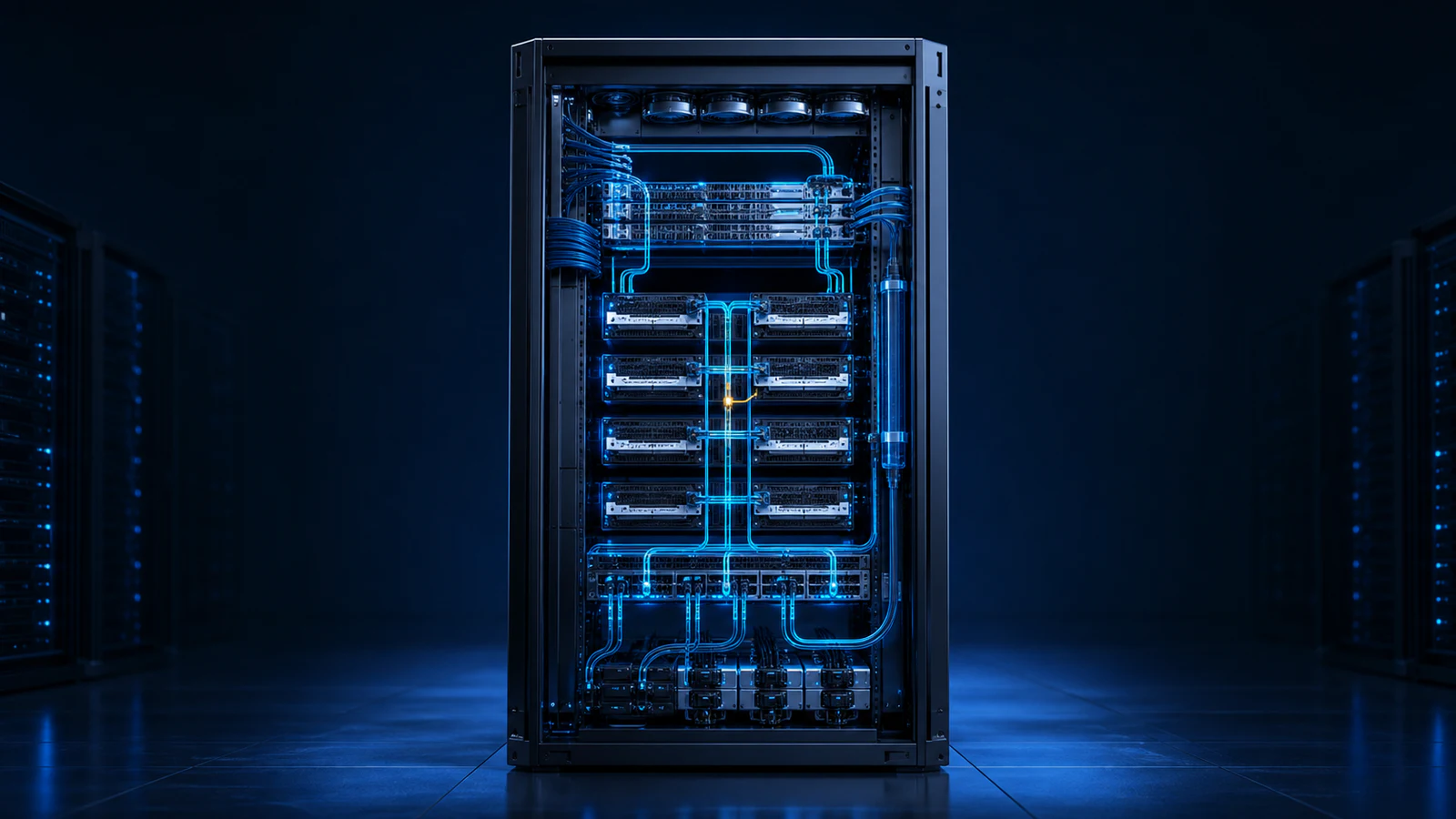
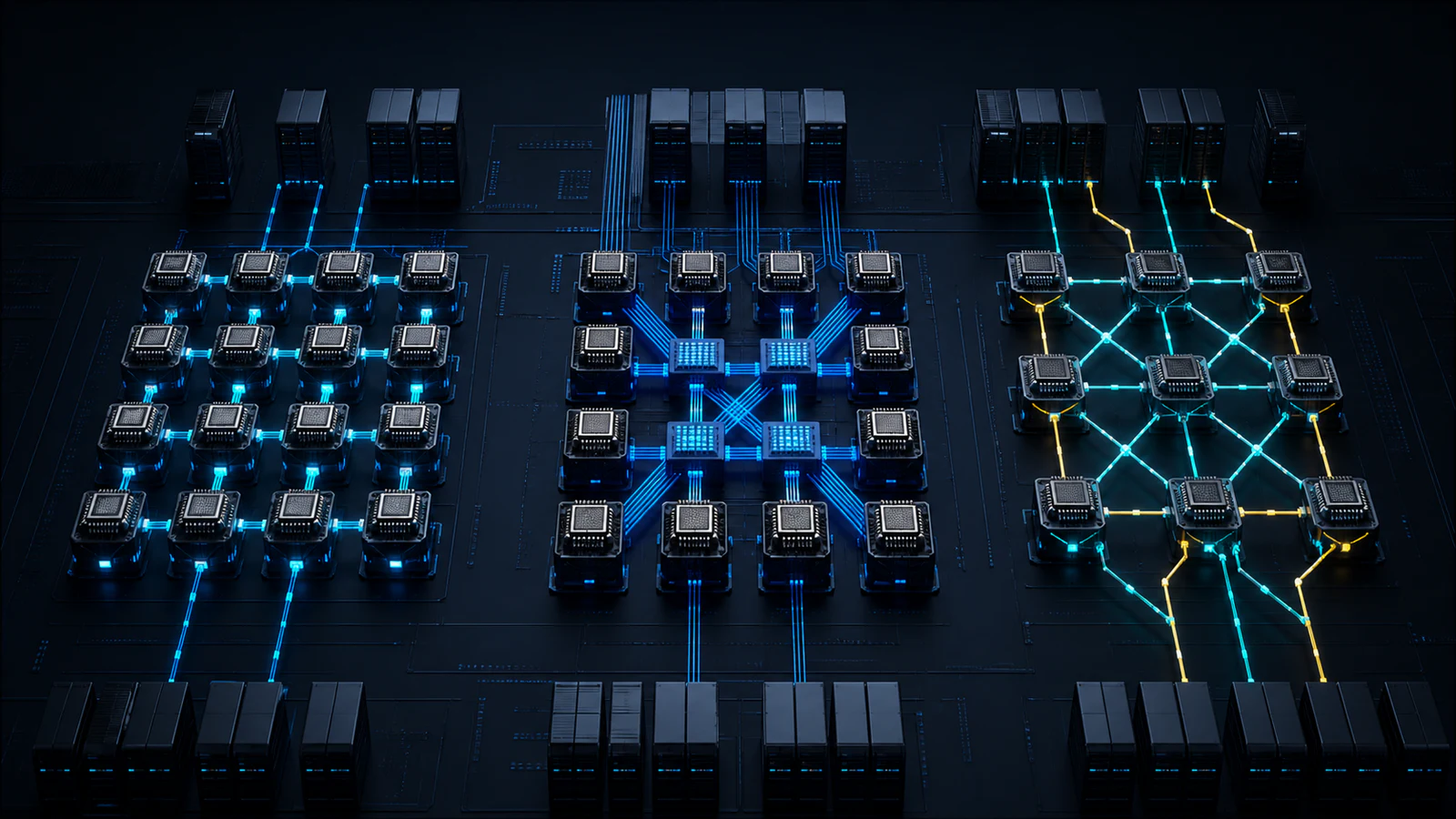
- Different fabric layers solve different distance and scale problems.
- Topology and congestion control affect useful accelerator performance.
- Collective tests must match the planned workload size and pattern.
- Cabling, telemetry and spare ports are part of the fabric design.
Accelerators work together by moving large amounts of data between devices. During distributed training, they exchange gradients and model states. During inference, they can exchange cache blocks, activations or routed expert data. The network can determine how much of the installed compute becomes useful application capacity.
There is no single fabric for every path. A system can use NVLink-class connections inside a compute domain, InfiniBand between servers and Ethernet for storage, management or a converged AI backend. Each choice has a role, cost and operating model. The design must connect these layers without creating a hidden bottleneck.
Start with traffic, not a protocol name
The workload defines message size, communication frequency and sensitivity to delay. Data-parallel training often uses large collective operations across many accelerators. Expert models can create uneven all-to-all traffic. Model-parallel inference may send smaller messages on a critical latency path. Storage and checkpoint traffic can also compete with compute communication if the design uses shared links.
Teams should record these patterns for the expected model sizes and node counts. A fabric that performs well for large sequential transfers may behave differently under many small synchronized messages. The design target must include throughput, tail latency, loss behavior and recovery after a link or switch failure.
NVLink connects the nearest accelerator domain
NVLink and related switch systems provide very high bandwidth between supported accelerators. They are commonly used inside a server or a tightly integrated rack-scale compute domain. Software can use this link layer for memory access and collective communication with lower overhead than a conventional host network path.
This layer has clear physical and platform limits. It depends on supported accelerator generations, switch design and system topology. Teams must understand which devices share the same domain and how communication crosses to another server or rack. The topology should be visible to schedulers and workload placement rules.
InfiniBand provides a purpose-built cluster fabric
InfiniBand has a long role in HPC because it supports low latency, remote direct memory access and strong fabric management. Current AI deployments use high port speeds, adaptive routing and congestion controls to support large collective operations. The technology also has mature tools for topology inspection and link diagnostics.
Its value depends on correct implementation. Switch tiers, oversubscription, cable quality and routing policy can reduce effective bandwidth. Operations teams need knowledge of subnet management, firmware compatibility and error counters. A fabric cannot be treated as a set of passive cables after commissioning.
Ethernet is developing for AI backend traffic
High-speed Ethernet is widely available and fits existing network skills and procurement models. Remote direct memory access over Converged Ethernet can reduce host overhead, while modern congestion controls support loss-sensitive traffic. The Ultra Ethernet specification adds transport and management features designed for AI and HPC scale.
Ethernet still requires disciplined design. Priority flow control, explicit congestion notification, buffer behavior and routing must work as one policy. A shared enterprise network without this engineering can produce variable results. Many organizations therefore use a dedicated backend fabric or a clearly isolated traffic class for accelerator communication.
Validate the fabric as a system
Port counters and a successful link state are only the first checks. Teams should run point-to-point bandwidth and latency tests, then collective tests across the exact topology used by the workload. Results must be recorded by node count, message size and operation type. A heat map can expose a weak cable, incorrect route or oversubscribed switch tier.
Failure tests are equally important. Remove a link, restart a switch and confirm that traffic returns through the planned path. Monitor packet loss, retries, congestion marks and collective timeouts. These results become the baseline for later incident analysis.
- Keep compute, storage and management traffic boundaries explicit.
- Reserve ports and cable paths for planned growth.
- Use consistent firmware and tested transceiver combinations.
- Alert on error trends before application performance falls.
How Chainzano connects fabric and workload control
Chainzano designs the fabric with the compute, storage and facility plan. We map workload traffic to a topology, specify validated components and include installation, cable records and acceptance tests in the delivery scope. This creates a measurable path from each accelerator to its peers and data sources.
NAIM adds the control layer for connected compute nodes and workloads. Its desired-state model helps teams place services on known resources and keep runtime configuration consistent. Fabric telemetry can then be evaluated beside node and workload status instead of as an isolated network problem.
Plan expansion without changing the operating model
A fabric should have an explicit growth step. The design must show which ports, switch tiers and cable paths are used when the next rack arrives. It must also state whether the expansion preserves full bandwidth or introduces oversubscription. Power, cooling and floor space plans should use the same step so that network capacity does not arrive before the rest of the system.
Operations must remain stable as the topology grows. Naming, cable labels, firmware groups, telemetry and test commands should follow one pattern. A new rack should pass the same link and collective tests as the first rack, followed by a test across the expanded domain. This repeatability limits configuration drift and makes performance differences easier to isolate.
Capacity reports should show effective fabric use by workload and topology. Peak port traffic does not explain collective efficiency or congestion. Combine link counters with job placement, communication tests and service results. This evidence can show whether the next investment belongs in switches, additional paths, workload placement or application communication.