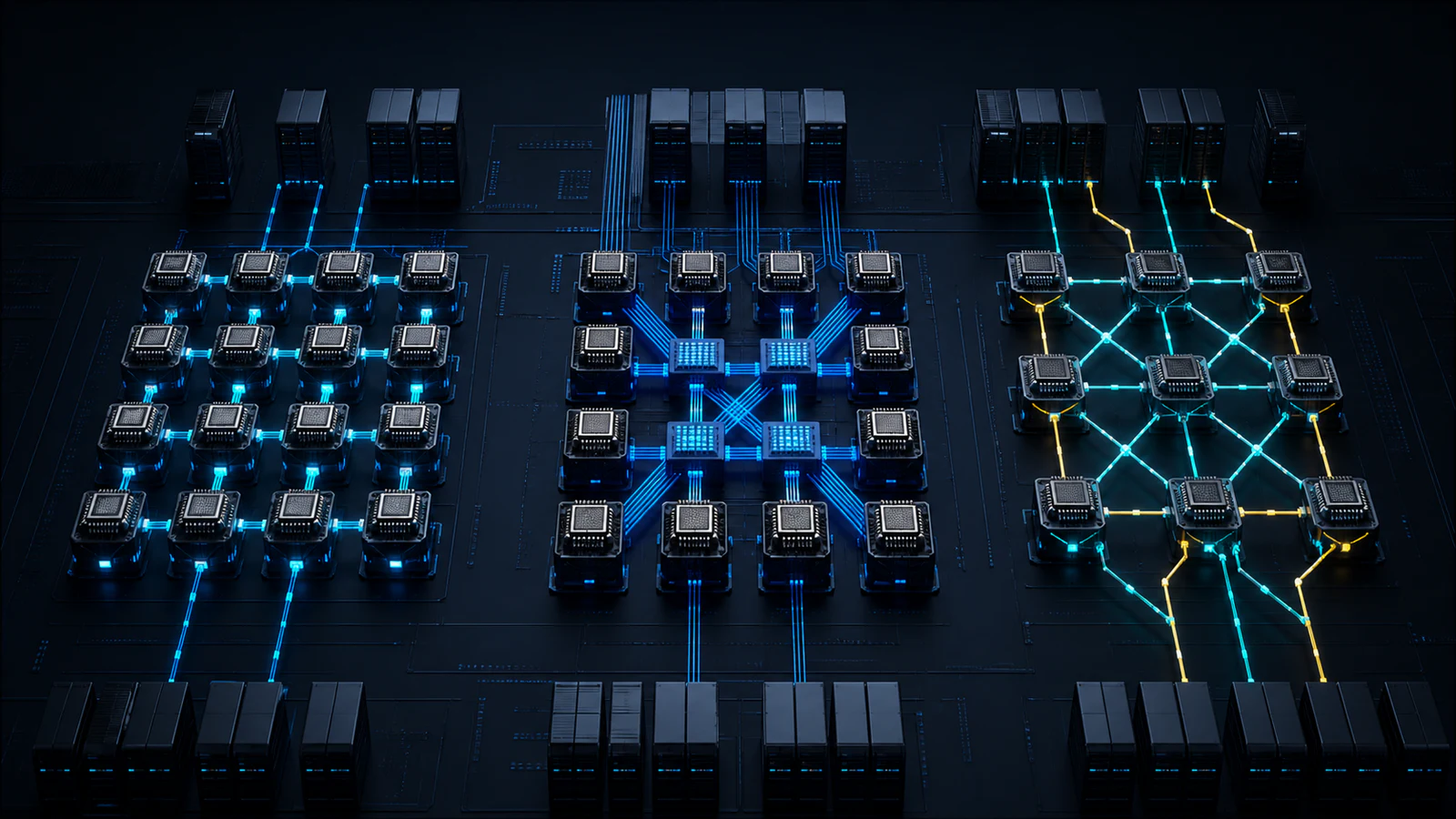

- The rack is becoming the practical unit of AI capacity.
- Compute, fabric, power and cooling must be designed together.
- Site readiness must be confirmed before equipment delivery.
- A repeatable rack design makes later expansion easier to control.
A large AI server can consume more power, move more data and produce more heat than a complete rack from an earlier data-center generation. Connecting several such servers creates dependencies that cannot be solved one device at a time. The accelerators need a fast fabric. The fabric needs planned cable paths. The cooling system must remove heat from every tray. The power system must handle both steady load and short peaks.
This is why current AI infrastructure is moving toward rack-scale systems. The rack becomes a defined capacity block with known compute, network, storage, power and cooling requirements. Teams can review that block before purchase, install it as one system and test it against a clear acceptance plan.
The workload sets the rack design
The correct design starts with the workload. Training, real-time inference, scientific simulation and data processing create different traffic and memory patterns. A training cluster may need frequent collective communication between every accelerator. An inference service may need more independent replicas, fast model loading and predictable request latency. These differences affect the number of accelerators, the fabric topology and the storage path.
A rack specification must therefore state the expected models, data volume, concurrency, job duration and growth target. Peak theoretical performance alone does not define useful capacity. The complete system must supply data and communication at a rate that keeps the accelerators working on the intended workload.
The fabric is part of the compute system
Modern accelerator systems exchange model states, gradients, cache data and intermediate results at high speed. A slow or oversubscribed link can leave costly processors waiting. Inside a rack, short high-bandwidth links connect accelerator trays and switches. Between racks, the network must preserve enough bandwidth for the selected parallel strategy and failure model.
The design must include switch count, port speed, cable type, path length and redundancy. It must also reserve ports for management, storage and future capacity. A diagram that shows only servers is incomplete. The useful compute unit includes every switch and cable that supports the workload path.
Power and cooling define the physical limit
Rack density is often limited by the facility before it is limited by available hardware. The site must provide the correct voltage, power distribution, protection and maintenance access. It must also absorb short load changes without causing instability. These checks require real equipment data and an agreed operating margin.
Cooling requires the same discipline. High-density racks can use direct liquid cooling, air cooling or a mixed design. The facility team must confirm supply temperature, flow, pressure, water quality, heat rejection and leak response. A cooling distribution unit may also need redundant pumps, service access and monitored valves. These requirements belong in the main design, not in a late installation note.
Rack scale changes delivery and commissioning
An integrated rack arrives with stronger dependencies between parts. Delivery planning must cover floor loading, lift limits, door sizes, transport paths, staging space and installation tools. Cable schedules and port maps should be approved before the rack is placed. The installation team also needs a safe sequence for power, cooling, network and management activation.
Commissioning then proves the system in layers. Teams inspect the physical build, test power and cooling, update firmware, confirm every link, run accelerator health tests and measure collective communication. The final workload test must show that the rack delivers stable results under a realistic load.
- Record every component, firmware version, cable and port.
- Test degraded modes such as a failed link, pump or power feed.
- Store baseline temperatures, power values and performance results.
- Define acceptance limits before the test starts.
A repeatable capacity block supports growth
A validated rack design gives the business a practical unit for expansion. Power, cooling, floor space, network ports and software capacity can be planned per block. Procurement can compare complete delivery options. Operations can use the same dashboards, tests and spare strategy for each added rack.
The design still needs revision when workloads or hardware change. However, the change starts from a measured baseline. This reduces uncertainty and helps teams identify which shared systems must grow before the next rack arrives.
How Chainzano delivers rack-scale capacity
Chainzano connects hardware selection with site preparation, installation, integration and lifecycle support. We define the workload and facility limits first. We then prepare a vendor-neutral bill of materials, delivery plan and acceptance procedure for the complete capacity block.
NAIM can manage the software side after commissioning. It keeps desired state for connected nodes, prepares and serves models, controls workloads and exposes operational status. This gives infrastructure teams one controlled path from installed capacity to active AI services.
Decisions to complete before purchase
Before purchase approval, the project team should freeze a small set of system decisions. These include the target workload, rack power envelope, cooling method, fabric boundary, storage path, management network and expected expansion unit. Each decision needs an owner and evidence from the facility, hardware and application teams. An unresolved item should appear as a project risk with a date for closure.
The team should also define the operating model. It must state who can schedule work, who monitors the facility, who responds to hardware faults and how vendor support is reached. Spare parts, maintenance windows and access rules affect the design. Completing this work before delivery reduces emergency changes during installation and gives every team the same definition of ready capacity.
Commercial documents should follow the same boundary. The contract should state which party supplies each cable, rack service, license, test and installation task. It should define acceptance evidence and the response when a component misses its target. This prevents gaps between hardware delivery and working capacity.